
Never Give In
Updated: Jan 3
Berlin. August 1936.

Sport, in the form of remarkable performances at the 11th Olympic Games, intertwines with significant political tension. Even if the gold medal exploits of a certain Jesse Owens put a sizable dent in the concept of Aryan supremacy, relentless propaganda, pomp, and ceremony, seeks to glorify the Nazi regime and the Third Reich.
Regardless, it is the life of a much less heralded American track athlete that draws me in. Not necessarily for a blistering final lap en route to an eighth place finish in the 5000 meter event. But, without question, for what follows.
Enter Louis Zamperini.
Born in 1917, he grows up in Torrance, California, part of a first generation Catholic family. He endures an ominous early life. Indeed, still an infant, he almost drowns, then nearly burns to death in a house fire.

Next, by nature rebellious, and constantly bullied when growing up, he takes up boxing in order to protect himself. Then finds a further outlet, and more importantly self discipline, through track and field. Becomes addicted to the rigorous training required for success. In 1934, sets a national high school record for the mile, one that stands for twenty years. This performance secures an athletic scholarship to the University of Southern California (USC).
By now fully motivated, Zamperini turns his attention to the Olympics. Confident, mentally strong, in superb physical condition, he duly overcomes oppressive heat and humidity during the USA trials to secure a place on the national team.
In one way, Berlin is something of a coming out party. Zamperini’s impressive, crowd pleasing finish in the 5000 meter race even draws plaudits from one Adolf Hitler, the German chancellor.
Alas, the onset of World War II soon cripples any future opportunities on the international sporting scene. Though in his athletic prime, Zamperini’s dreams of returning to the Olympics in 1940 and 1944 are dashed.
Yet, as one door closes, others open. Just not in the way he, or anyone else, might imagine.
Zamperini graduates from USC. Joins the Army Air Corps. Soon, on the heels of the December 7, 1941 Japanese bombing Pearl Harbour, he begins active combat. Serves as a bombardier on a B-24 Liberator. Appropriately, given his own life is about to change forever, the plane is named Super Man.

An April 1943 raid against the island of Nauru sees Super Man attacked and severely damaged by three Japanese Zeros. With the bomber no longer airworthy, Zamperini and several other crewmen transfer to Hawaii. Assigned to a different B-24, the notorious Green Hornet, they depart Oahu on a May 27 flight to search for a missing aircraft.
Tragically, due to engine malfunction, the bomber crashes into the Pacific. The severe impact kills eight of the eleven men on board.
Incredibly, against unimaginable odds, Zamperini and two others survive.
Miraculously, the trio manage to stay alive for over a month, subsisting on rainwater, small fish, and birds that land on their makeshift raft. Not even energy sapping heat, terrifying shark attacks, wicked storms, and being strafed by Japanese aircraft, weakens their resolve.
Throughout the harrowing ordeal, Zamperini’s physical and mental toughness shines through. Hard earned lessons from his youth bear dividends, namely that no matter what obstacles one faces, he or she can deal with them. His life as an elite athlete further helps condition him against severe pain and discomfort. While, by exercising the mind, by asking questions, by singing songs, by telling tales about his childhood, even through humour, he keeps himself and crew mates distracted, motivated, and battling to survive.
Sadly, tail gunner Francis McNamara eventually does succumb to extreme hunger and thirst. Yet, though adrift for another two weeks with almost no food or water, the emaciated Zamperini and co-pilot Russell Phillips, somehow wash ashore on the Marshall Islands.
An excruciating 47 day trial comes to an end.
If only.
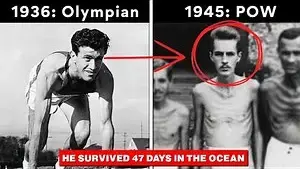
Brutally, their situation goes from bad to much, much worse. Captured then interred by the Japanese, the airmen are severely beaten and tortured as prisoners of war for two terrifying and agonizing years.
Transferred from camp to camp, Zamperini runs afoul of a particularly sadistic guard named Mutsuhiro “The Bird” Watanabe. Yet, starved, psychologically abused, stripped of his dignity, violently assaulted on a daily basis, given up for dead by his own nation, Zamperini survives by virtue of incredible courage and indomitable will.
Early in September 1945, Japan surrenders.
Eventually, on returning home, Zamperini receives a hero’s welcome.
Still, initially at least, post war life proves far from easy. Faced with severe PTSD, he takes refuge in the bottle. However, once again, simple strength of character allows him to overcome alcoholism and, in the process, saves his marriage to wife Cynthia.

Not surprisingly, countless awards and accolades pour in over the years, until his passing in 2014 at the ripe old age of 97. From Olympian to three time Purple Heart recipient. A motivational speaker, author and evangelist of significance, he inspires followers to confront and overcome their struggles, to acknowledge the destructiveness of hate, to embrace the power of forgiveness.
In this latter regard, life comes full circle in 1998 during a torch relay for the Winter Olympics in Japan. Invited to take part, he jogs through the mountains of Naoetsu, near to the site of the most barbaric camp during his war time captivity.
And so, in every way, shape and form, it is hard not to marvel at the life and times of Louis Zamperini. Though he never considered himself a hero, his was a hero’s journey of the highest order.
Back to the present. 2025 winds to conclusion. For my money, in far too many places around the globe, this has been a lousy year. An “annus horribilis.” For too many people, for far too many reasons, a year to forget.
Conflict and violence reign. Tyrants, wannabe dictators, run unchecked. A lack of morality, civility, justice, and basic leadership, glaringly obvious. Greed, racism, dishonesty, extreme cruelty and corruption, adds to the underlying rot.

As a necessary counterbalance, I choose instead to think of Zamperini. Of his vitally important actions and his powerful messages.
Of unfathomable courage, even in the bleakest situations. Of forgiveness and its healing power. And that, however black the night, light will always follow the darkness.
That perseverance is key. In times of strife and trouble, never give up. Never give in. As every problem has an answer.
And so, let us seek out other Zamperinis, and their ilk.
They are out there. Rally along side them, in a world that may bend, at times badly, but refuses to break.

Help make 2026 a time to remember, for all the right reasons.
Happy New Year.
-------------------
Editor’s note:
Zamperini’s story may be found via book and film. Both titled Unbroken, they merit reading or viewing.
The Purple Heart is one the most prestigious US military decorations.



Comments