
The Ultimate
Mid September. Victoria, BC.
Almost without warning, the daylight starts to slip away.
The sun fights a losing battle against the trees. Shadows lengthen. Quietly, the temperature dips. Early autumn colours begin to gather, the leaves on the ground and on the trees a blend of yellow, burnt orange, and red.
I sit outside in the garden patio. My mind roams wild, a whirling kaleidoscope of thoughts and memories from this and previous summers.
Of one in particular.

1976.
A first year in college successfully completed, I look forward to a belated high school graduation present.
Alongside my father, also a sporting fanatic, we travel east to Montreal. The small matter of watching the Olympic Games, the XXI Olympiad, on the docket.
For me, still a somewhat shy, uncertain, impressionable teenager, the three weeks in July prove transformative.
Our days take on a familiar routine. Up at the crack of dawn, breakfast at one of the coffee shops dotted along the Westmount streets. The flavourful, sesame seed bagels, fresh from the wood fired ovens, quickly become a staple.

Then to Atwater, where we descend to join the Green Line, part of a newly revamped subway system. Fourteen stops along the way towards the Olympic Park. Place des Arts, Frontenac, Joliette, Viau, just to name a few. Every station unique in terms of its architecture and artwork. Each one both functional, beautiful, and reflective of the city’s cultural identity.
Montreal’s sheer size, hustle, and bustle, is intimidating. The majority of its nearly three million inhabitants seem to be bilingual, moving effortlessly back and forth, mid conversation when required, between French and English.
Still, I knuckle down, chance my arm whenever I can with a few stock French phrases. Scan the various signs for directions and information, try to decipher any news flashes I might see on television or summaries I might read in the papers. All as the city, with Expo 67 only just in its rearview mirror, readies to host another major international event.
On one level, I do sense underlying tension. Note the security, a first ever concerted armed military presence at a global sporting showpiece. Not surprising given the brutal terrorist attack on Israeli athletes by Palestinian militants four years earlier at the Munich Olympics. But jarring, nonetheless.
The media reports further on other concerning issues.

First, mayor Jean Drapeau guarantees the Olympics will not run a deficit. Yet overly ambitious construction projects soon produce a crippling $1.5 billion debt. A sporting financial disaster, it takes nearly 30 years to pay off. Though an architectural jewel, the Olympic Stadium is only just completed in time. Destined to be labelled the “Big Owe,” its construction dogged throughout by worker strikes and widespread corruption.
Secondly, 29 countries, mostly African, then choose to boycott the Games. Politics and sport clash, as calls for an embargo of South Africa, due to its racist apartheid policies, go unheeded by New Zealand’s national rugby team.
Still, over 6,000 athletes, representing 92 countries, eventually take part.
Determined to take in as much action as possible, my father and I confirm our tickets for gymnastics, basketball, boxing, and track and field.
Part of a crowd of 73,000, we then take our seats at the opening ceremonies. Half that many jam the streets outside. Millions more watch on television. Goosebumps for sure, as all acknowledge the Israeli team, whose members sport black ribbons to commemorate those lost in the 1972 Munich massacre.

Then, the noise and bedlam build to a crescendo. Thousands of flags wave in unison. To a sea of red and white, the Canadian squad, last to enter, arrives in the stadium.
I eagerly await what is to follow, as the Olympics never fail to provide a steady stream of heroes, of history made, and of lessons imparted.

And so it proves.
Where to start?
How about with gymnastics? A 14 year old Romanian named Nadia Comaneci announces herself to the world. Arguably the star of the Games, she wins multiple medals, including the gold for all round performance. Indeed, in a stunning display on the uneven bars, she becomes the first gymnast ever to record a perfect “10”. Ironically, with such a mark previously considered unattainable, the results board, with space for only three figures, can only register the score as 1.00.

More drama soon follows. Japanese gymnast Shun Fujimoto shatters his right knee during his floor exercise. In a remarkable display of raw courage, with his team in contention to win a gold medal, he somehow hides the severity of his injury. Then goes on to complete his program on the rings, perfectly executing a triple somersault dismount. Gritting his teeth, he somehow maintains balance despite landing in agony from a considerable height.
Next, to the basketball arena. My father regales me with tales of his own hoops coaching career, of how his best ever team, in the late 1960s, is knocked out of provincial championship contention by a tiny Vancouver Island school from Chemainus. A school led by a small but supremely talented guard named Billy Robinson.

Now on the world stage, the mercurial and ultra combative Robinson leads Canada on a breathtaking ride all the way to the Olympic semifinals, before falling to a powerhouse USA team.
Boxing highlights another American juggernaut, arguably the greatest Olympic group the USA ever assembles. Five capture gold medals, while four of them, including Sugar Ray Leonard, go on to become world champions at the professional level.

Still, for my father, drawing on some of his own bouts at school and then in the navy, it is Teofilo Stevenson who catches his eye. I watch mesmerized as the physically imposing Cuban heavyweight lays waste to opponents with devastating left jabs and thundering right hooks.
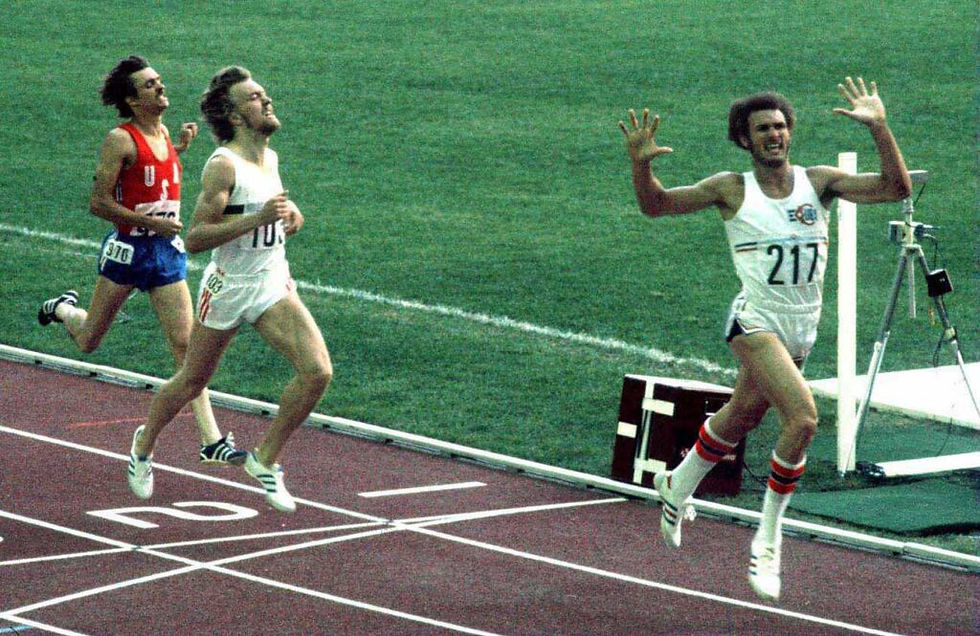
However, it is track and field that takes pride of place. Day after day, we arrive for the start of competition at the Olympic stadium, soon witness to countless remarkable performances.
Take another Cuban, the majestic Alberto Juantorena. He becomes the first man to win both the 400m and 800m at the same Olympics.
Then, the flying Finn, Lasse Viren, repeats his own double win from 1972, again claiming gold in the 5,000m and 10,000m races. Incredibly, on short notice and to great acclaim, he then enters the marathon, hoping to win in order to match the exploits of the famous Czech, Emil Zatopek, in 1952.
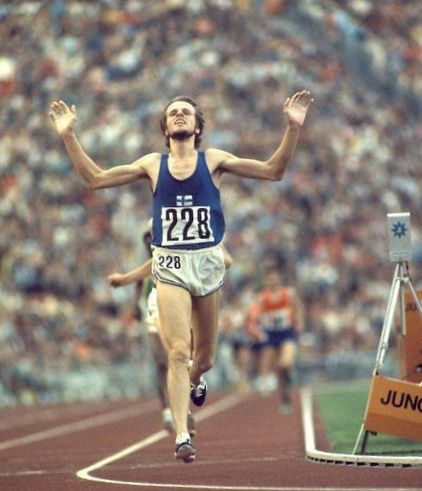
Others also seek the limelight. The Soviet Union’s Viktor Sanayev captures a third consecutive triple jump gold, while American Bruce (now Caitlyn) Jenner, sporting a ratty t-shirt embossed with the slogan “Feet, Don’t Fail Me Now,” breaks the world record in the decathlon. Another USA star, 20 year old phenom Edwin Moses, brand new to the event, sets a new world mark in the 400m hurdles.
To cap things off, Hasely Crawford sneaks home in the 100m final, from in lane 1 in a time of 10.06 seconds. By so doing, he secures a first ever gold medal for Trinidad and Tobago.
So much to discuss and debate, as my father and I return via the Green Line each evening to our home stay in Westmount. So many examples of strength and supreme athleticism, of mettle, resilience, and self-belief. Of unselfishness, hard work, humility and character.
Alas, too soon, our trip nears an end.
July 31. The last of 198 medal events takes place on a cool and rainy Saturday evening at the Olympic stadium.
All eyes focus on the infield. There, a sole figure, tall and stringy, stands among the puddles on the high jump apron.
The bar is set at 2.23 meters, almost 7’4”. Canadian Greg Joy faces a third and final attempt to clear the height. For the host country, still without a gold medal, athletic successes have been few and far between.

Rocking back and forth, clapping his hands, Joy exhorts the mostly partisan crowd to follow suit.
Time seems to stand still. Finally, he begins to move. Sweeping forward in an arc, lithe and agile, with huge bouncy strides, he approaches the bar. Somewhere in the background, the Olympic flame flickers in the gloom.
The tiny pockets of water make for treacherous footing. Nonetheless, Joy plants securely, then soars upward as the assembled throng holds its collective breath.
All at once, we comprehend what has taken place. Joy stands triumphant in the pit, arms aloft after a successful jump. Guarantees at least a silver
medal. Not necessarily a gold medal, but one that feels golden.
Thousands of rabid supporters explode in sheer jubilation, the yelling, screaming and thunderous applause rolling like huge waves throughout the packed stadium. It is an iconic moment, and one which sets the entire country alight.
The next afternoon, the final ceremony brings proceedings to a formal close.
It is not a perfect Olympics by any means. In addition to security concerns, financial chaos, and boycotts, other issues also rear their ugly head. The Soviet pentathlon team is disqualified for cheating; one member having rigged his epee to register a hit when there was not one.
East Germany dominates women’s swimming. Then finishes a lofty second on the overall medal table to the Soviet Union. However, suspicions soon arise about these achievements, from to the systematic use of performance enhancing drugs to the dumping of serum and used syringes in the nearby St. Lawrence River.
Even the legendary Viren cannot escape scrutiny, accused of blood doping while preparing for, and recovering from, his gruelling race schedule.
Still…….
--------------------
Back in the garden, slowly I return from my reverie. The Montreal lights dim, then fade to black.
As I pull my sweater tight to ward off the chill, I consider the words of Grantland Rice. The famous American sportswriter once penned “it is easy to forget; it is hard to remember.”
I decide this opinion, in this case at least, does not apply to me. Fifty years has gone by, but I will never forget the summer of 1976. I know what I see, what I hear, what I read, and what I learn.

Namely, that an Olympic Games, even allowing for any warts, is the ultimate competition.


Comments